

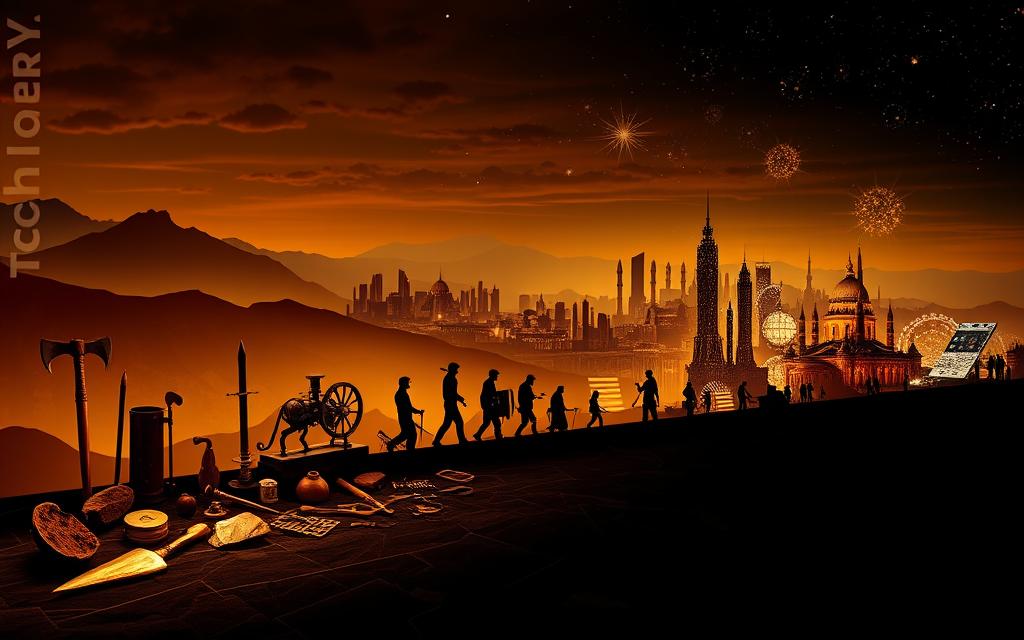
Our journey through the history of technology shows how much we’ve changed. From basic stone tools to advanced artificial intelligence, it’s clear we’re very good at inventing new things.
Technology has always been key to our progress. Each new discovery helps us move faster, changing our world in big ways.
Readers exploring from stone tools often end up considering calypso capital markets software as part of the same topic.
This discussion overlaps with find website tools techniques, especially for readers comparing from stone tools with similar issues.
We’ll look at how tools and systems have changed over time. From simple tools to smart machines, we’ll see the big steps that helped us grow.
Learning about our tech journey helps us understand what we can do now and what we might do next. It shows our never-ending quest to get better, adapt, and solve problems with new ideas.
Understanding What Is the Evolution of Technology
Technological evolution is a deep journey for humanity. It shows our ability to turn knowledge into useful tools that change our world. From simple tools to complex systems, it shows our growth and future.
Defining Technological Evolution and Its Significance
Technological evolution is about the growth of tools, techniques, and systems over time. It shows how humans adapt to challenges and opportunities.
Related Posts:
- What Is Calypso Technology Capital Markets Software…

- What Is the Information Technology Industry Key…

- What Is Medical Technology All About Innovations in…

- How to Find the Technology a Website Uses Tools and…

- An Advantage of Cloud Native Technology Scalability…

- How Technology Is Used in Farming Precision Agriculture

This journey is key to our survival, society, and culture. Each new technology opens up new possibilities and builds on old ones.
Technological progress follows a pattern. Simple tools lead to more complex ones. This shows how early human innovation laid the groundwork for today’s tech.
Early Human Innovation: The Stone Age Foundation
The Stone Age was our first major technological era, lasting about 3.3 million years. Finds in Kenya’s Lake Turkana give us a glimpse into these early times.
Our ancestors, like Australopithecus, made basic tools that changed our lives. These early steps in prehistoric technology started tool making and use.
Millions of years ago, people made sharp stone flakes and hammer stones. These show they were made on purpose, not by accident.
Basic Toolmaking and Survival Technologies
Early stone age tools helped with survival. Sharp flakes helped process food, while hammer stones cracked bones and nuts.
Tool making followed patterns in different places. The Oldowan industry, named after Tanzania’s Olduvai Gorge, was the first standardised tool making.
These tools gave many survival benefits:
- They helped get and prepare food better
- They made defending against predators easier
- They made using resources more efficient
- They helped people work together using tools
Creating basic tools helped us develop important skills. These skills were the base for all future tech progress. It shows how simple ideas can lead to big changes.
Agricultural Revolution: Foundation of Civilisation
The move from nomadic hunting to settled farming was a huge change for humans. This period, known as the Neolithic revolution, started modern society as we know it today.

Domestication of Plants and Animals
About 12,000 years ago, humans started growing wild plants and taming animals. This change from foraging to farming led to more food. This food helped support bigger, permanent homes.
Domestication needed careful watching and selective breeding. Early farmers picked the best plants and animals to manage.
“The agricultural revolution allowed humans to become masters of their food supply, not just servants.”
This new agricultural technology helped communities stay in one place. Having a steady food supply meant less searching for food. This was a big change from hunter-gatherer societies.
Irrigation Systems and Early Engineering
By 6000 BCE, places like Mesopotamia and Egypt had complex irrigation systems. These systems brought water to crops, helping them grow in dry areas.
Early engineers built canals, dams, and places to store water. These projects needed great planning and teamwork. They showed advanced social organisation.
The table below shows key irrigation developments during this period:
| Region | Time Period | Irrigation Innovation | Impact |
|---|---|---|---|
| Mesopotamia | 6000 BCE | Canals from Tigris/Euphrates | Enabled farming in dry seasons |
| Egypt | 5500 BCE | Basin irrigation from Nile | Stabilised agricultural output |
| Indus Valley | 5000 BCE | Gravity-fed channels | Supported large populations |
These engineering feats turned poor land into fertile areas. Food security soared in early civilisations.
The Invention of the Wheel and Its Impact
Around 3500 BCE, the invention of the wheel changed everything. It first appeared in Mesopotamia, likely for pottery. Later, it was used for vehicles.
The wheel quickly spread through trade networks. It made moving goods, people, and ideas easier than before.
Its effects were huge:
- Trade improved with wheeled carts
- Agriculture got better with wheeled ploughs
- Building techniques improved with pulleys
- Military used chariots
This shows how simple inventions can lead to big changes. The wheel is one of humanity’s most lasting inventions.
The Neolithic revolution changed human life a lot. It allowed for settled communities, specialisation, complex societies, and knowledge growth. This set the stage for future civilisations.
Ancient Civilisations: Monumental Technological Leaps
Ancient civilisations were the first to show great technological growth. They built on farming to create complex societies. The Bronze and Iron Ages saw many cultures make big leaps in technology.
These leaps changed how humans lived and worked. They set the stage for future progress.
Mesopotamian Writing Systems and Mathematical Advances
The Sumerians in Mesopotamia created cuneiform writing around 3200 BCE. This Mesopotamian technology used wedge-shaped marks on clay for writing. It helped keep records and tell stories.
They also made a sexagesimal system (base-60) that we use today. This system helped in math and astronomy. Their math tablets show they could solve complex problems.
Egyptian Architectural and Engineering Marvels
Ancient Egypt’s buildings are amazing examples of ancient engineering. They needed great planning and math to build these structures. Egyptian builders made them last for thousands of years.
The Egyptian pyramids are the best example of this skill. Building them needed precise cutting and moving stones. They also had to align with the stars.
They also built great irrigation systems and used papyrus for writing. Egyptian technology included medical tools, ships, and quarrying methods. These helped them build their amazing buildings.
Greek and Roman Technological Contributions
Greek innovators made big steps in science and mechanics. Archimedes found key principles of levers and buoyancy. He also invented the screw pump.
Greek architects also improved temple building. They used math and new column designs.
Roman engineers took Greek ideas and made them better. They built lasting projects like aqueducts. These carried water over long distances.
Roman roads helped trade and military movements. They also made concrete for the Pantheon’s dome. Their tech included siege engines, plumbing, and building ideas that lasted for centuries.
| Civilisation | Key Technological Innovations | Lasting Impact |
|---|---|---|
| Mesopotamian | Cuneiform writing, mathematics, irrigation systems | Foundation of writing systems and time measurement |
| Egyptian | Pyramid construction, papyrus, medical tools | Architectural techniques and recording materials |
| Greek | Theoretical mechanics, architectural orders, screw pump | Scientific methodology and mechanical principles |
| Roman | Aqueducts, concrete, road networks | Infrastructure engineering and building materials |
These ancient advances laid the groundwork for future tech. They showed how to solve problems and keep knowledge. Each civilisation added something new to our tech history.
Medieval Period: Preservation and Global Innovation
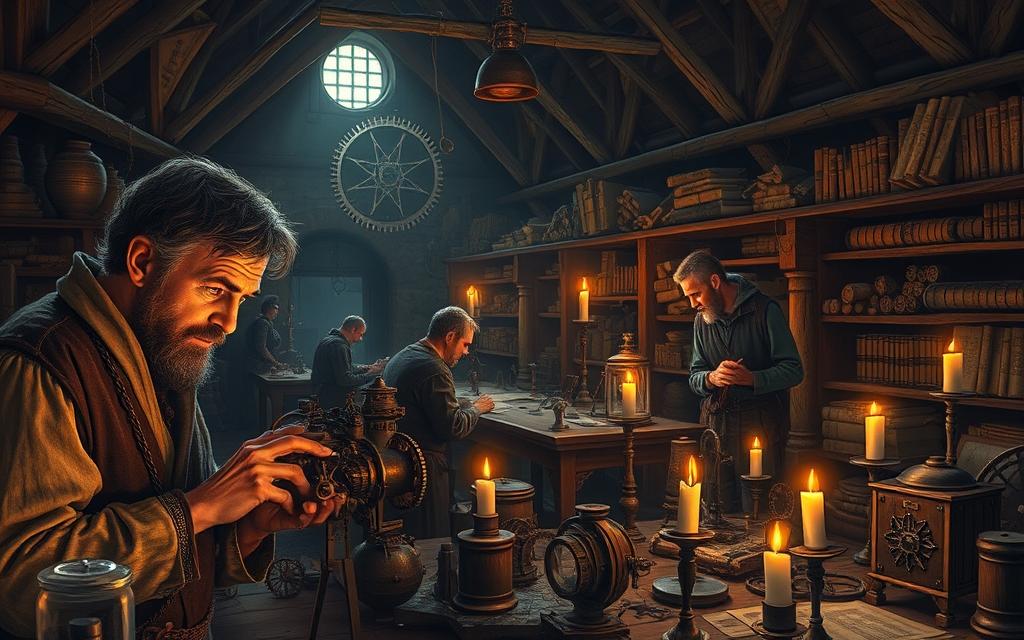
The medieval period is often seen as a time of little progress. Yet, it was filled with groundbreaking innovations from three major cultures. Islamic scholars saved ancient knowledge and made new discoveries. Chinese inventors created technologies that changed global exploration. European craftsmen built complex mechanical devices.
Islamic Golden Age and Scientific Preservation
From the 8th to the 14th century, Islamic scholars protected ancient wisdom. They built libraries and translation centres. These places kept Greek, Roman, and Persian texts alive.
In Baghdad, the House of Wisdom was the top place for learning. Islamic mathematicians improved algebra and trigonometry. Astronomers built advanced tools. Medical experts wrote detailed books that influenced Europe for centuries.
Chinese Inventions: Paper, Gunpowder, and Compass
Medieval China made three key inventions that changed history. Paper spread knowledge across Asia and Europe. The compass invention in 1044 CE changed navigation.
Gunpowder, starting as an alchemy experiment, soon changed warfare. It was first used for fireworks but soon became a military tool. This technology reached Europe, changing battles forever.
These Chinese medieval inventions opened up new ways to communicate, explore, and fight. They shaped the next few centuries.
European Medieval Technologies and Craftsmanship
European craftsmen made incredible mechanical devices with limited resources. The mechanical clock, appearing around 1250-1300, kept time accurately. Windmills evolved from Persian designs to more efficient models.
Gothic cathedrals showed amazing engineering with flying buttresses and stone vaults. Water-powered mills ground grain and processed materials. Metalworkers and glassmakers made better armour and stained glass.
These achievements set the stage for Europe’s later technological lead. The medieval period was far from stagnant in its technical progress.
The Industrial Revolution: Mechanisation of Society
Machines started replacing manual labour on a large scale. This changed society’s structure. It moved from farming to making things on a big scale, shaping our modern world.
Steam Power and Transportation Revolution
James Watt’s steam engine in 1765 was a big step forward. It made old mining pumps work better and power many machines.
Transport changed with steam power. Richard Trevithick showed the first steam train in 1804. Robert Fulton’s steamboat in 1807 cut travel and shipping costs.
Textile Machinery and Factory Systems
Textile making moved from homes to factories. New tools like the spinning jenny and power loom made fabrics fast.
Factories became the main place for making things. This led to new jobs and cities built around factories.
Things got made faster and cheaper. This made goods for everyone and changed jobs in society.
Telegraph and Early Communication Technologies
Samuel Morse’s telegraph invention in 1844 changed how we talk long distance. It was faster than sending messages by horse.
The telegraph network linked cities and businesses. It helped businesses work together and news spread fast.
This was the start of new ways to share information. It led to phones and the internet, changing how we connect today.
Twentieth Century: Exponential Technological Progress
The twentieth century saw a huge leap in technology that changed our world. It moved from slow changes to fast, big steps in many areas at once.
Electricity and Mass Production Systems
Thomas Edison’s electric light bulb in 1879 started a big change. It made electricity common, changing homes and work places.
Electric power helped make factories work better. They could run all day with new lights and machines. This made making things cheaper and faster.
Henry Ford’s assembly line changed making things even more. It made goods cheaper for everyone. This was a big step forward.

Automotive and Aviation Technologies
Nikolaus Otto’s engine in 1876 was key for cars. Karl Benz made the first car in 1885, a big step in automobile history.
The Wright brothers flew in 1903, showing we could reach the sky. This made the world feel smaller.
Cars and planes changed how we travel and work. They opened up new ways to connect and do business worldwide.
Nuclear Technology and Its Dual Applications
Enrico Fermi’s nuclear reaction in 1942 showed great power and danger. It showed how much energy atoms could hold.
Nuclear power could give us endless clean energy. It started to power homes, solving energy problems.
But, it also raised big questions about weapons. Nuclear bombs changed the world, making everyone worry about safety.
This shows how science and responsibility go hand in hand. It’s a big lesson from the twentieth century.
The Digital Revolution: Computing and Global Connectivity
The late 20th century saw a huge change in technology. This change changed how we work, talk, and find information. It made our world more connected than ever before.

Early Computers and Microprocessor Development
It all started with John Atanasoff’s first electronic digital computer in 1937. This machine was the start of today’s computers. Then, in 1947, Bardeen, Brattain, and Shockley made the transistor at Bell Laboratories.
This small device changed electronics by replacing big vacuum tubes. It made computers smaller, faster, and more reliable. Next came integrated circuits and microprocessors, leading to the personal computer era.
Internet and Global Communication Networks
While computers were getting better, another big step was happening. In 1974, Vinton Cerf and Robert Kahn created TCP/IP. This was the key to the internet’s success.
This innovation let different networks talk to each other easily. The internet grew fast in the 1980s and 1990s. It went from a tool for the military and academics to a global way to communicate. This was a key moment in internet history, marking the start of the information age.
Mobile Technology and Personal Computing Revolution
The Altair 8800, launched in 1974, was the first personal computer. The Apple II in 1977 made computers available to homes and small businesses. This made computing accessible to more people.
The biggest change came in 2007 with the iPhone. It combined computers, internet, and phones in one small device. Smartphones gave everyone powerful computing in their pockets, ending the digital revolution started by big machines.
| Year | Innovation | Key Figures/Companies | Significance |
|---|---|---|---|
| 1937 | First Electronic Digital Computer | John Atanasoff | Foundation of modern computing |
| 1947 | Transistor Invention | Bardeen, Brattain, Shockley | Enabled electronics miniaturisation |
| 1974 | TCP/IP Protocol | Cerf & Kahn | Internet communication standard |
| 1974 | First Personal Computer | Altair | Democratised computing access |
| 2007 | First Smartphone | Apple iPhone | Mobile computing revolution |
These technologies merged to create our digital world. Now, billions have access to computing power, and we can talk to anyone, anywhere. The digital revolution keeps growing, leading us to new technological frontiers.
Artificial Intelligence: The Contemporary Technological Frontier
In today’s digital world, artificial intelligence stands out as a game-changer. It’s about making machines that can think and learn like us. This field shows our drive to create intelligent machines.

Early AI Research and Machine Learning Foundations
The idea of AI started in the 1950s with Alan Turing’s big questions. Back then, researchers tried to make machines think like us using rules and symbols.
Machine learning changed AI’s game. It lets systems learn from data, not just follow rules. This way, they can spot patterns and predict things.
Deep Learning and Neural Network Advancements
Neural networks have been a big deal for AI. They’re like the brain, breaking down information in layers. This helps machines understand and act on complex data.
AlphaGo beating Lee Sedol in 2017 was a huge moment. It showed AI can win at strategy games. This breakthrough showed how far AI can go in understanding and making decisions.
Modern AI Applications and Ethical Considerations
AI is changing many areas today. In healthcare, it helps diagnose diseases from images. Finance uses AI for trading and fraud checks. And in manufacturing, it predicts when machines need fixing.
Tools like ChatGPT (2022) can write and answer questions. They help with creative tasks. Other AI tools are being used in many fields.
But AI raises big ethical questions. It might replace jobs and could be biased if trained on biased data. It also collects a lot of personal information, raising privacy concerns.
To make AI right, we need to be open about how it works. We should use diverse data and make sure someone is accountable. The future of AI depends on finding a balance between progress and ethics.
Conclusion
Our look into technology’s growth shows a story of human progress. We’ve moved from stone tools to advanced artificial intelligence. Each step has built on the last, shaping our world and how we interact.
Now, technology is moving towards a more connected digital world. AI’s quick growth shows how far we’ve advanced. Looking back, we see how different areas of science have come together faster.
The future of tech looks set to change even more. We’re heading towards greener solutions, space travel, and more ethical AI. Our journey from basic tools to complex systems keeps going, driven by our curiosity and creativity.
FAQ
What is technological evolution?
Technological evolution is the ongoing process of developing and adopting new tools and systems. It has shaped human society, driving changes in economy, society, and culture. From stone tools to artificial intelligence, it has been a key part of our history.
When did humans first begin using tools?
Humans started using tools about 3.3 million years ago. They used sharp stone flakes and hammer stones for hunting and food. These early tools were the start of all technological progress.
How did the Agricultural Revolution change society?
The Agricultural Revolution changed society from nomadic to settled farming. It led to food surpluses and bigger populations. This also led to early engineering projects like irrigation systems in Mesopotamia and Egypt.
What was the significance of the invention of the wheel?
The wheel was invented around 3500 BCE. It changed transportation, agriculture, and construction. It made moving goods and people easier and helped build more complex structures.
Which ancient civilisations made major technological contributions?
Many ancient civilisations made big contributions. Mesopotamia developed writing and maths. Egypt built pyramids. Greece and Rome made advances in architecture and science.
What role did the Islamic Golden Age play in technological progress?
The Islamic Golden Age was a time of great learning. Scholars preserved and expanded on ancient knowledge. This led to big advances in maths, astronomy, medicine, and engineering.
How did the Industrial Revolution transform technology and society?
The Industrial Revolution was driven by innovations like the steam engine. It mechanised production and changed transportation. It introduced factories and revolutionised textiles, changing economies and daily life.
What were the key technological developments of the 20th century?
The 20th century saw huge progress. Electricity became widespread, and cars and planes were invented. Nuclear power was also developed, changing industry, warfare, and energy.
How did the digital revolution begin?
The digital revolution started with early computers. The invention of the transistor in 1947 was a big step. The internet and mobile technology, like the iPhone, made digital tools accessible to everyone.
What is artificial intelligence and what are its implications?
Artificial intelligence (AI) is about creating systems that can learn and solve problems. Advances in AI have led to applications like ChatGPT. But AI also raises concerns about jobs, bias, and privacy.
How has technology impacted global communication?
Technology has changed global communication a lot. From writing to the internet, it has made sharing information fast. It has connected cultures and helped economies grow.
What are the future trends in technological evolution?
Future trends include more AI and automation, green technologies, and space exploration. These will change how we live, work, and interact with our environment.
 Marcin Wieclaw